TED talks are always interesting. This one a little more so than usual.
Category: Articles
Best Practices For Preparing Music for an iPad
I spent most of new years day going through binders and either scanning or shredding (sometimes both) music I have. I was amazed at how many binders of things I had, and a LOT of it consisted of my II-V patterns and various exercises I wrote for myself.
Anyhow, if I had the finale file to something I had in the binder, I shredded the paper version and proceeded to tweak the finale file to better take advantage of the iPad. Here is what I learned.
First, you can make the margins practically nothing. In one version of my II-V patterns I have it formatted for a double sided printer so whatever side the holes are to be on, it is 0.5″ from the end of the page on the right and 0.75 on the left (to allow for holes). On an iPad, you can set that to 0.1 all around. The results are quite stunning.
Standard Page with 0.5 Margins
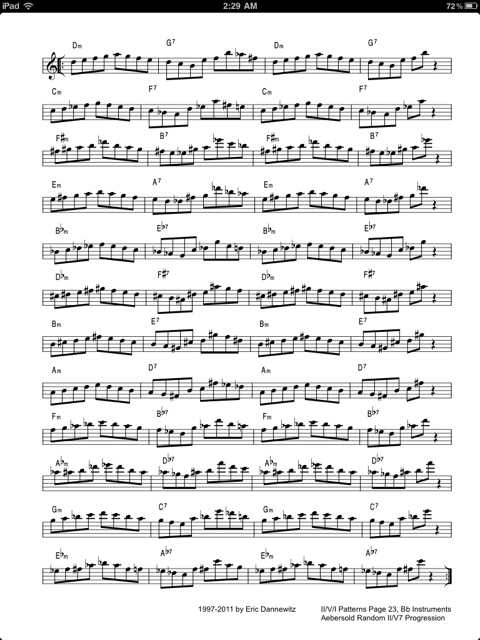
Page with 0.1 Margins on Right and Left

Second, I was able to enlarge the size of the music with 0.1 margins. The result is a page that takes advantage of the iPad’s display, and is easier to read than the pain Jane dumping a standard page to PDF to iPad. So, a note to all you people providing stuff out on the web and who are iPad or Tablet enthusiasts…..you need to reformat your PDFs. It doesn’t take much, and in Finale it was simply making a new Part and then tweaking the layout. About 3 to 5 minutes of work for something that looks a lot better.
Here are the patterns formatted for iPad. I will be doing a mass update of files to include iPad versions. Enjoy.
 Random II-V Patterns - Bb (iPad) (4.9 MiB, 94 hits)
You do not have permission to download this file. Go register first.
unRealBook vs. GigBook
I received some iTunes gift cards from students this year, same as in previous years, and I decided to use some of them on two iPad apps that a lot of people have been buzz about, unRealBook ($4.99) and Gigbook ($4.99).
Let me start off by saying that both programs absolutely suck on how you get stuff into them. Part of that is Apple’s fault. It would be nice if Apple would allow access to the area where iBooks are being stored, but that doesn’t seem to be the case at the moment, though they now allow Apps to talk to iTunes and play music from your library which unRealBook does. It would be idea for both of these developers to come up with something to allow easy importing/syncing of PDFs. I suppose one could use DropBox.
A slicker alternative, PadSync ($9.99) works great. Strangely enough on yet another iPad Music reading App recommended it. Yet, this too doesn’t really offer anything I really want. I would LIKE to have say a folder called SaxBooks and have ONE of these programs, when I sync to iTunes or run some syncing program, update any changes or additions. Is that so much to ask? Hence, this is why I really like using iBooks. It syncs to iTunes, and I can keep all my PDFs in iTunes, tag them, etc.
Moving on past the pain in the butt that is putting files on you iPad into one of these programs, what can you expect? Which one works better? First, lets look at Gigbook. This is a slick program. You can organize scores into Binders, make set lists, organize by composers, genre, key, tempo, time. You can make it part of a Collection so you can bookmark 400 page PDF fake books for songs. It feels like a proper iPad App, like my favorite iPad App Reeder.
UnRealBook has a lot of neat features. You can draw on your music, different pens, colors, etc. Save it. Undo it. Email the changes. Very cool. You can link a PDF to a song in your iTunes library and play it. VERY COOL. You can export Pages, send files via Bluetooth, Get files from DropBox or a URL, email PDFs, pages. There are lots of things you can do. However, the navigation around the program isn’t very “iPad-like”. Plus, once you’ve gotten used to the Binders and Collections that GigBook has…..
It’s a tough call to pick a winner. Feature wise, unRealBook is the best. The ability to mark up your PDFs and play things out of your iTunes library and attach those things to PDFs. Total thumbs up. Gigbook needs to step up and have these things. Interface wise, Gigbook is clearly the best. And the Collections and Binders are pretty invaluable…….
Winner…..Gigbook. Of the two, it is the one that is really the best thought out and implemented. If unRealBook redid its interface, and implemented something similar to Binders and Collections, then it would be the winner.
Couple of notes:
Both programs work with the Airturn BT-105 (seriously, who the hell names these things).
Both programs DO NOT and SHOULD read PDF fields like Title, Author, Subject and Keywords that are in PDFs. I take the time to tag my PDFs, it would be nice for these programs to read them.
Both programs should be able to read and use bookmarks in PDFs. Seriously, I bookmark important PDFs or RealBooks I have in PDF format.
Both programs should allow cropping of PDFs. After I did this experiment, it can really help make things more readable.
Both programs should have contrast controls, like GoodReader.
Either Apple or these guys really should find a way to access PDFs in iBooks or come up with some easy way to manage PDFs between the Mac and iPad.
AND it would be nice to have TEXT searching in PDFs. Programs like GoodReader allow this, and for 400 Page RealBooks, it would make finding a song easier.
So, Gigbook. Now if someone wants to send me forScore 2 ($4.99) to play with………I might have to revisit all this (HINT HINT). Or if GoodReader had a few of the features of Gigbook and unRealBook (Binders, ability to draw on PDFs).
Kitara
Misadigital is going to release their Kitara Guitar in April. While it is a guitar, the concept could be perhaps taken to the realm of EWI. Imagine perhaps two touch screens coupled with a breathing sensor…..hmmm…..Yamaha? Akai?
iPad in Education
From the Santa Cruz Sentinel:
“Before, during and even between classes at Hillbrook School this fall, seventh-graders have been spotted on the Los Gatos campus, sometimes burbling Spanish or Mandarin phrases into the glowing screen in their hands, other times staring into it like a looking glass,” Bruce Newman reports for The Mercury News.
“iPads — the Apple of almost every adolescent’s eye — are being provided to students at several Bay Area public and private schools this year, including Hillbrook, which claims to be the only K-8 school in America using tablet computers in class and sending them home,” Newman reports. “This has led to a lot of 12-year-olds swanning around the wooded hillside campus, talking to their iPads.”
It just makes sense. It’s cheaper, more “green”, and more efficient. Now imagine having all your music books in an iPad. Or all that Lit and Analysis stuff accessible instantly. Or having some great ear training Apps to help with sight singing. Soon……it’s happening as we speak…..
Best Practices To Scan Old Books into PDFs
Yes, the iPad is amazing. Ok, sure, there are some other makers coming out with devices too. Regardless of what you get, you are probably at some point going to want to convert some of your tattered books into digital format. But how? What should I use?
Fear not, here are some guidelines to do it as I’ve converted quite a few of my old books that were falling apart into excellent PDFs. First, you need a scanner. A sheet feed scanner on something like a Brother 7340. I used a Brother 7420 myself, and it works great. Good Macintosh support. You could use a lot of other different solutions as well, but you really need to have a sheetfeeder scanner (ie: you can put 20+ pages on it and let it do it’s stuff).
Second, you need some sort of paper cutter to cut the bindings off, and any books that are oversized (like Rubank) need to be trimmed a little to fit in the scanner’s sheetfeeder. You can use scissors I suppose, but a paper cutter is easier, cleaner, and does it better.
For scanning, I’ve found that 300dpi B&W uncompressed TIFF is the way to go. I don’t do JPG or compressed TIFF because I am going to let the PDF part of the process do all the compression when I’m ready. I put in a stack of pages in the sheet feeder, and have it go. When its done, then I put the other side through the scanner. When that is all done, I go through the scans and number them (01…09….20….etc) and make sure that the scanner didn’t take two or more pages in by mistake (it will happen) and to see that they pages have all the stuff on the page (as in nothing was cut off during the scan). The cover and back I’ll generally use the flatbed scanner on the unit to make color scans. The covers are usually thicker anyways and don’t go through the feeder well (if at all).
Ok, so, now you have all these TIFFs, I use Adobe Acrobat to assemble them (“Combine Files into PDF”). The middle setting (lower right filesize) is the setting I use, into a Single PDF file. You also need to make sure the pages are in order then go.
Acrobat will then assemble all the files together, and display the result. Now, the next thing to do, which is why I use Acrobat, is to use the Tools->Recognize Text. Why you say? Well, it does OCR any text in the PDF, which is helpful if you need to search something, but it also will do things like straighten any crooked pages and stuff. Little things that will make your PDF look great. So run it. When it is done, then do an Apple-D and type in info for the PDF like the title, author, some key words. Then save.
Done! Now you have a nice digital copy for yourself. It is really great using the iPad to practice with, it remembers where you were in each PDF, and you can make bookmarks (which can transfer to your computer), etc. Notes. Great stuff. Here is an example page
Electro-Swing
This has been happening in the SF Bay area for a while, and it seems to be happening in the UK now as well.
“A paddle steamer moves slowly down river, over-run with a gaily dressed throng of party animals in cloche hats, homburgs, spats, waistcoats, ball masks, and feather boas. Moustaches – some waxed – flourish. The bar sells out of champagne within an hour of leaving dock and the dance floor fills with dandy couples throwing each other about. This is not a scene from F Scott Fitzgerald, but Halloween 2010 on Steamboat Bordello, a floating event on the Thames, and the speakers are pumping out a striking new music that looks set to be the sound of this season’s parties: a revamped version of Jazz Age flavours that mixes Dixieland brass with electronic percussion.”
Check out the video as well. Good stuff. I like this….
James Moody Dies
James Moody passed away today. Sad. Another legend has left the building…….
UPDATE: NYTimes has an article up now about him
Make Your Own Fingering Charts EASILY!
Bret Pimentel has hit it out of the park with this. Simply the best thing I’ve come across on the net for months……his online Fingering Diagram Builder…which also works on the iPad!

I’m pleased to present something I’ve been working on, on and off, for a while now. I’m pretty excited about it, and I hope you will check it out and let me know what you think.
This project developed from my own need to quickly and easily create fingering diagrams for the woodwind instruments that I play and teach. Frequently I find myself scribbling saxophone altissimo fingerings onto a scrap of paper during a private lesson, cutting-and-pasting at the photocopier to put together simplified charts for a woodwind methods class, or penciling cryptic markings into musical scores to remind myself which pinky finger to use.
Simply amazing and well overdue on the web. Thanks Bret!!!!!
Tour Of The C.G. Conn Factory circa 1911
Found this link to a picture tour of the C.G. Conn factory from about 1911. Probably not much has changed. There are actually some iTunes Podcasts from Yamaha that show how they make instruments. Very high tech.
Best Practices To Clean a Mouthpiece
Discovering Google Reader is both a blessing and a curse. A blessing because I now am updated on a TREMENDOUS amount of stuff I’m interested in. Curse, because I now monitor SaxontheWeb. Generally, the posts there are…..subpar to be nice. However, there are occasional questions that come up that some try to answer thoughtfully. Like this one on Can Bleach Damage a HR Mouthpiece.
As an owner of a Vintage Meyer Brothers Hard Rubber mouthpiece, and the owner of two Hard Rubber Slant Signature Otto Links, I’d NEVER SOAK my mouthpieces in Bleach. At all. Period. Even diluted. Period. My practices in cleaning a mouthpiece are to use lukewarm water, antibacterial soap, and a old soft toothbrush. I mildly scrub the mouthpiece out with the toothbrush and soap. That lasts maybe 30 seconds. I wash it off, then if there is some calcium deposits, I use Doctor’s Products Mouthpiece cleaner to remove them. This stuff works really well. Then, if I still want to make sure it is clean, I’ll take a Clorox Disinfectant wipe and run it over and through the mouthpiece (these don’t have Bleach).
Done. The short version of cleaning, like when I put on a new reed, is to run a Clorox Disinfectant wipe through the mouthpiece and on the outside. I think every other time (or every few months) I’ll do the more involved cleaning described above.
Sonny Rollins Interview
The UK Magazine The Telegraph has a great interview with Sonny Rollins about turning 80, touring the world, and generally being awesome. Check it out.
Wither and die sheet music/music stands?
There are already several apps for the iPad for viewing sheet music PDFs, including apples iBooks. It makes sense, the iPad is just about the right size for viewing a page of music.
Now, there is a mount for iPads.

$39.95. Now we just need a Bluetooth foot peddle page turner…..for that price….
And for saxophone players, if you use this with a microphone stand, this also solves the problem of how to hear yourself….as in the iPad should provide some reflection of the sound back at you if you have it just above the bell. Wonder if that would mess with the microphone capturing one’s sound correctly…..I should get one and try it out….
UPDATE: Oh, the foot switch is coming!
Mouthpiece Rack
Most of the time saxontheweb is annoying, but sometimes a gem comes out. And here is one such gem….a mouthpiece rack.

Wood, brass door stoppers with the tops cut off. Genius. Good job!
Buddy Collette Dies
From Kanascity.com
“Buddy Collette, a Grammy-nominated jazz saxophonist, flautist, bandleader and educator who played important roles in Los Angeles jazz as a musician and an advocate for the rights of African American musicians, has died. He was 89.”
If you have never heard of him, check him out, especially his flute albums. Great stuff.